
The Left-Right Paradigm
and Originalism vs. Revisionism

“Originalism” is the doctrine of interpretation of language fixed in meaning as a snapshot in time; it is unchanging, always imbued with the precise intent of he who spoke it at the time he spoke it. You may recognize this terminology as applied to jurisprudence and interpretation of the Constitution, and you may further recognize that it is broadly considered a “rightist” approach to interpretation as championed by none other than Clarence Thomas. Leftist approaches to the topic of interpretation of both the Constitution, and language broadly, tend towards the euphemistic “living” language, or that in which meaning changes over time to be interpreted as most appropriate for the purposes of modernity, and was the preferred framework of late Justice Ginsburg. This living interpreter framework is both fundamentally, and definitionally, “revisionist;” what else could one call the revision of meaning to suit ones needs if not “revisionism?” Revisionism- is not merely a concept applicable to language and meaning, but also to history where it is, as with language, generally the territory of “leftist” approaches to understanding.
What, however, is this left-right paradigm? Even in its most appropriate, true, and applicable manifestation the left-right paradigm is a severely flawed conceptual framework for pegging deep political, and ideological movements along a two-dimensional graph. The flaw is simply that two dimensions cannot remotely grapple with the intricacies or nuances of ideology except at the absolute lowest of resolutions. This is where we get into so much trouble when attempting to project modern debate onto this graph, as with the addition of more ideologies the resolution scales rapidly outside of that which might be captured in any detail in two dimensions. The addition of a second, up-down dimension, has improved things a bit, but is not by a lot, and it is not in the most common usage – especially when communicating verbally.
That said, we can attempt to achieve a more correct version of this left-right paradigm through the adoption of the originalist interpretory framework, and the rejection of the revisionist framework. Doing so is quite simple, and we can demonstrate it through the effect of simply changing scale. First, let us examine the left-right version of media fancy: that of the communism-fascism scale.
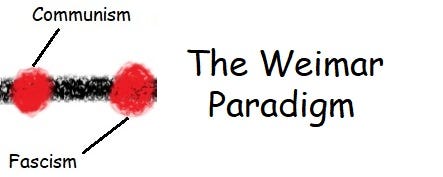
As you see, on this scale the “far left” is represented by Communism, or more precisely by international Communism in the vein of dialectical materialism, whereas the “far right” is represented by Fascism. By choosing this scale to elevate the media invites us to determine where between Communism and Fascism our particular political persuasions fall. Would Progressives be, perhaps, just left of center? Just how close to Fascism are Conservatives, anyhow? More importantly, where did this scale come from in the first place?
As with very nearly every catastrophic idea of the last two centuries it turns out this graph can be traced to Germany – though, at the time, it was still known as the Weimar Republic. In the early days of the twentieth century the Fascist Brown-shirts of Weimar took to the streets in a wave of violence that would portend the rise of Hitler. We all learned this as school children, but what we may not have learned is who they were taking to the streets against, and why. It turns out that Weimar was deeply embroiled in tumult and political violence before the Brown-shirts ever took to the streets. You see, before the Brown-shirts there were the Red-shirts: a group of committed international Communists who took up the mantle of the Bolsheviks in attempting a revolution in the image of Lenin’s, and then Stalin’s Soviet Union. These revolutionary Red-shirts caused the streets of the Weimar Republic to flow red with blood in political violence against all non-Communists; they weren’t picky in distinguishing between Fascists, liberals, and conservatives. As with the laws of physics, the laws of society tend to dictate that for every action an equal and opposite reaction, and in the days of the Communist Red-shirts this “opposite” reaction came from the Fascist Brown-shirts who met the Red-shirts in the streets in pitched battles to put an end to the Communist violence. For those wondering how the German people could have ever sided with the Fascist Nazis look no further than those who were perceived as worse: the Communists who, unlike early Fascists, were not discriminating in their violence.
How ever did this Weimar Republic paradigm – that snapshot in time of early 1900’s Germany – get transposed onto American politics? For those familiar with my writing you will also be familiar with my answer: the Communists of the Frankfurt School. You see, as the writing on the wall became clear that it was the Fascists who would claim victory in Weimar, many of the Communists who could do so fled the country. Some of those Communists fled to America, and some specifically to New York where they would establish the American version of their Institute for Social Research at Columbia University. One can understand how a bunch of dysfunctional, angry Communist Red-shirts who had just suffered defeat to Fascist might have that dichotomy color their thoughts, and thereby transpose this paradigm into American politics. However, a truer representation of the left-right spectrum in America post-introduction of the Continental European ideologies of Hegel, Nietzsche, Rosseau, et al would appear as follows.
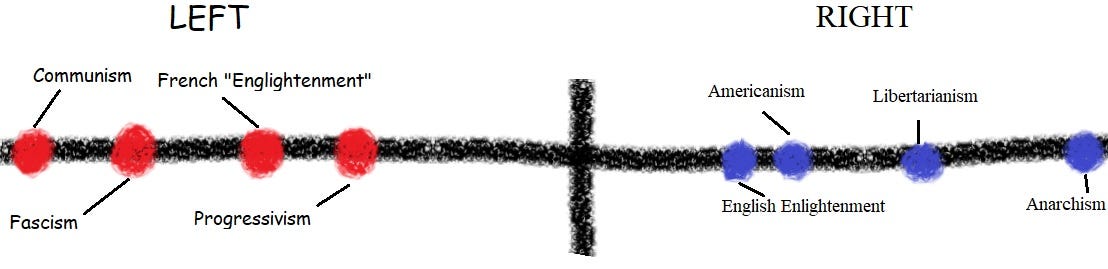
You see, Fascism was considered “rightist” by the Communists because Fascists sought to retain nationalism within their conceptualization of Socialism, whereas the Communists believed that Socialism was a project for the entire world to undertake as the attainment of “critical consciousness” by the Proletariat, the revolution, ensuing dictatorship of the Proletariat, and then immanentization of the eschaton into the Communist utopia must bring in all people, worldwide, at once. Put another way here’s some things that Fascism has in common with Communism: Socialism, collectivism, Statism (or Globalism), collective ownership, equity (forced equality of outcome), utopian religiosity. Here’s the one thing on which Communists and Fascists fundamentally disagree: internationalism vs. nationalism.
This left-right, Communist-Fascist paradigm was never meant for America, and it never made any sense here. The American political tradition is not that of the French Revolution, Rosseau, Kant, Hegel, or Marx. The American political tradition was that of the Protestant Reformation, the English Enlightenment, Smith, Locke, and Paine, individualism over collectivism, the rejection of state power – let alone state worship – and the devolution of power to the lowest fundamental units: the sovereign individual, and the family. The American political tradition was never to spar with Communists as Fascists over the retention of national identity Socialism vs. Globalist Socialism: it was to tell both to go to hell, and stay off our lawn.